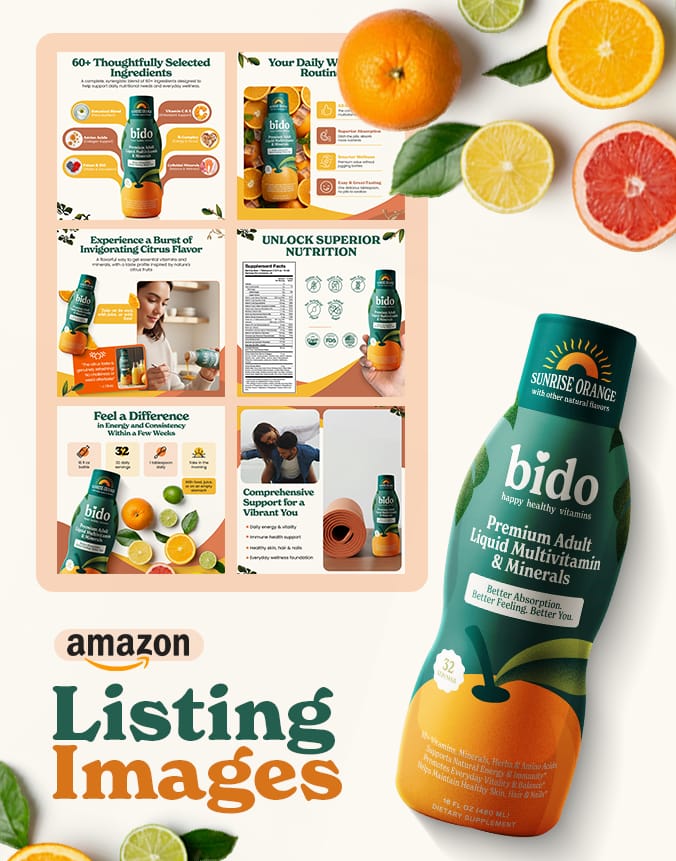
Seven images per SKU, selected by category behaviour and competitive gaps. Not a fixed template. A strategy built around what your market actually responds to.
Years Amazon
Listings optimized
Brands served
Advertising Partner
1,000+ verified reviews
Amazon Service Provider Network
Listing images are Desverto’s highest-revenue service for one reason: they are the highest-leverage element on an Amazon listing.
The sequence is direct. Your main image determines whether a buyer clicks. Click-through rate determines how much organic and paid traffic your listing actually receives. Without the click, nothing else on the listing matters. Price, bullets, reviews: all of it is invisible to the buyer who scrolled past.
Once you have the click, the six secondary images carry most of the conversion work. Buyers scan them before they read your title or bullets. A well-structured secondary image set answers the three questions a buyer is running in their head: What does this product actually do? Will it fit my situation? Why this one and not the cheaper option next to it?
There is a third effect that does not get talked about enough: good images reduce returns. When a buyer has an accurate, detailed picture of what they are getting (dimensions, materials, what is in the box, how to use it), the gap between expectation and reality shrinks. Fewer surprises. Fewer returns.
This is why roughly 26 percent of Desverto’s annual revenue comes from this one service. It is what most Amazon sellers prioritize first, and why most clients find us through listing images before they add anything else.
Every Amazon category has its own visual norms. The image types that drive performance for a supplement brand are not the same ones that work for outdoor furniture or consumer electronics. Designing without knowing this means producing images that look fine in isolation but disappear in a real search results page. We do not use a fixed seven-image template. The set we design for your SKU is chosen based on what your category responds to and where your competitors have left gaps.
White background, Amazon-compliant, product shown at the angle that highlights its key feature. The goal is to stand out in a search results row of 10 to 20 competing thumbnails.
Features, benefits, and specifications shown visually. For supplements, this handles ingredient callouts. For physical goods, it surfaces the specs buyers compare across listings.
Product in a real-life setting so buyers can picture owning it. The context is category-specific.
Your product's advantages against competitors or alternative approaches. Designed to stay within Amazon's guidelines while still making the case clearly.
Important for products with non-obvious use cases or multi-step setup. Reduces pre-purchase hesitation and post- purchase returns.
Size shown with visual scale references. Most buyers will not calculate dimensions from the bullet points. They need to see it.
Engineering details, materials, certifications, and quality markers that do not photograph well at a distance.
Results or transformations shown side by side. Common in beauty, home, and health categories.
Step-by-step lifecycle or usage sequence.
Materials, craftsmanship, or third-party certifications.
Everything in the set or kit shown together.
Internal components revealed by sectioning the product. Used to demonstrate build quality, engineering, or layers that are otherwise hidden.
The seven images we produce for your SKU are chosen from this list based on what your product needs and what your category rewards.
How We Decide
Before design starts, we run two parallel analyses.
The first is a competitor analysis. We look at the top 10 to 15 listings in your category and map which image types they use, which are executed weakly, and where there is a visual gap your images can own. This shapes which seven types we produce and what each image needs to lead with.
The second is buyer research. We pull from the review text and Q&A sections of competing listings to understand what buyers are actually confused about, what they praise, and what causes returns. This feeds directly into the infographic, how-to-use, and features images, where the goal is to answer the real questions buyers have before they ask them. Keyword research informs which product attributes deserve visual prominence based on what buyers search for in your category.
Most agencies start with a creative brief and a brand kit. We start with competitor gaps and buyer language, then build the brief from that. The output looks different because the input is different.
Listings with our graphics have seen 20–35% increases in conversions.
Every asset is Amazon-compliant and ready to upload.
Projects completed for brands across all different product categories.
How We Handle Variants
For brands with multiple variants, the right approach depends on how different the variants actually are from each other. There are three models.
Each variant gets its own full image set, designed independently. This is the right call when variants have meaningfully different use cases, target buyers, or visual stories. A "compact" and "large" version of a storage product, for example, are not just size differences. The buyer considering each one has a different problem. The images should reflect that.
One master image set is designed to represent the product family as a whole, without being specific to any individual variant. This works well when the product is visually simple and the variants are shallow (different colors of the same item, for example). The buyer experience is consistent across variants and the design investment is concentrated rather than spread thin.
The structural design (layout, infographic logic, lifestyle context) is built once and adapted per variant. A color-change product gets the same seven images with the product swap and color palette updated. This is the most common approach for brands with 3 to 10 color or finish variants. It keeps costs reasonable without sacrificing consistency.
We assess the right model during scoping and tell you what makes sense before you commit to a scope. For most catalog projects, this conversation changes both the budget and the output quality significantly.
Every project includes:
Seven custom-designed images per SKU, built from a competitor and buyer analysis, not a template.
We design listing images. We do not shoot photography.
Most projects use a combination of product photos you provide, lifestyle stock assets, and design work our team produces. For brands that need photography alongside design, Desverto offers a separate product photography service. If you are not sure whether your existing photos are usable, send them over before you commit to a scope. We will tell you what works and what does not.
We do not promise specific conversion rate improvements.
Conversion depends on your price, your review count and rating, your category competition, your fulfillment type, and factors that have nothing to do with image design. What we can do is give your listing images that are competitive in your category, technically compliant, and built on a real analysis of what buyers in that category respond to.
What we do know from working across 3,500+ listings: weak images are one of the most common reasons a listing underperforms relative to its price and reviews. If your conversion rate is significantly below your category average and your images are more than 18 months old, the images are the right place to start.
“Desverto supported my entire Amazon launch — from A+ content to storefront. Everything turned out visually cohesive and professional. They were patient, detail-focused, and didn’t stop until it was perfect. Highly recommended!”

Director at FitPro
“We’ve been working with desverto team for over a year on our Amazon brand. From A+ content to product images, they’ve consistently delivered high-quality work on time and exactly to our specs. Super reliable and easy to work with — highly recommended.”

Director at ANACTRO
“Desverto helped me launch my skincare line on Amazon — from SEO and listing images to storefront design. Everything looked incredibly professional. Super responsive and went above and beyond every step. I’d definitely recommend them.”

Founder, Men’s Skincare Brand
Listing images are Desverto’s most purchased standalone service. These are not required add-ons, but they are often added once images are in place:
Seven image-and-text modules that replace the plain-text description on brand-registered listings.
• More DetailTitle, bullets, description, and backend search terms built around keyword research for your category.
• More DetailThe branded strip of tiles above A+ that links to your storefront and surfaces related products.
• More DetailFull Amazon storefront design that turns brand visitors into multi-SKU buyers.
• More DetailWe work with images you send us. Most projects use a combination of your existing product photos, lifestyle stock assets, and our in-house design and illustration work. For brands that also need photography, Desverto offers a separate product photography service. We tell you exactly what files we need before the project starts.
It depends on how different the variants actually are. For color variants that share the same structure, we usually use a mixed approach: one master design adapted per color rather than seven fully original images per variant. For size or style variants with meaningfully different use cases or target buyers, a specific approach makes more sense and each variant gets its own set. We assess this during scoping and tell you what we recommend before you commit.
Typical turnaround is 7 to 10 business days from when we receive all required assets: your product images, brand guidelines if you have them, and a completed project brief. Rush timelines are available. Each revision round adds approximately 2 to 3 business days.
Yes. If you have a brand kit, we design within it. If you do not, we use your existing listing as a reference and document the design choices in a style guide so future work stays consistent.
Every project includes three free revision rounds. A revision round means you review the full image set and give consolidated feedback in one pass. We implement it. Fragmented feedback across multiple messages extends the timeline. Additional rounds beyond three are billed at $50 each.
No, and we will not. Conversion depends on pricing, reviews, category competition, and a range of factors outside image design. What we guarantee is that your images meet Amazon’s technical specs, are informed by real competitor and buyer research, and accurately represent your product.
Yes. Amazon’s core image specifications are consistent across US, UK, EU, Japan, and other marketplaces. If your international listing needs localized text, metric measurements, or a different lifestyle context, we scope that as part of the project.
Our mission is to empower your growth through innovative solutions and unwavering dedication. we value trust, collaboration, and delivering excellence in everything we do.
CEO@desverto