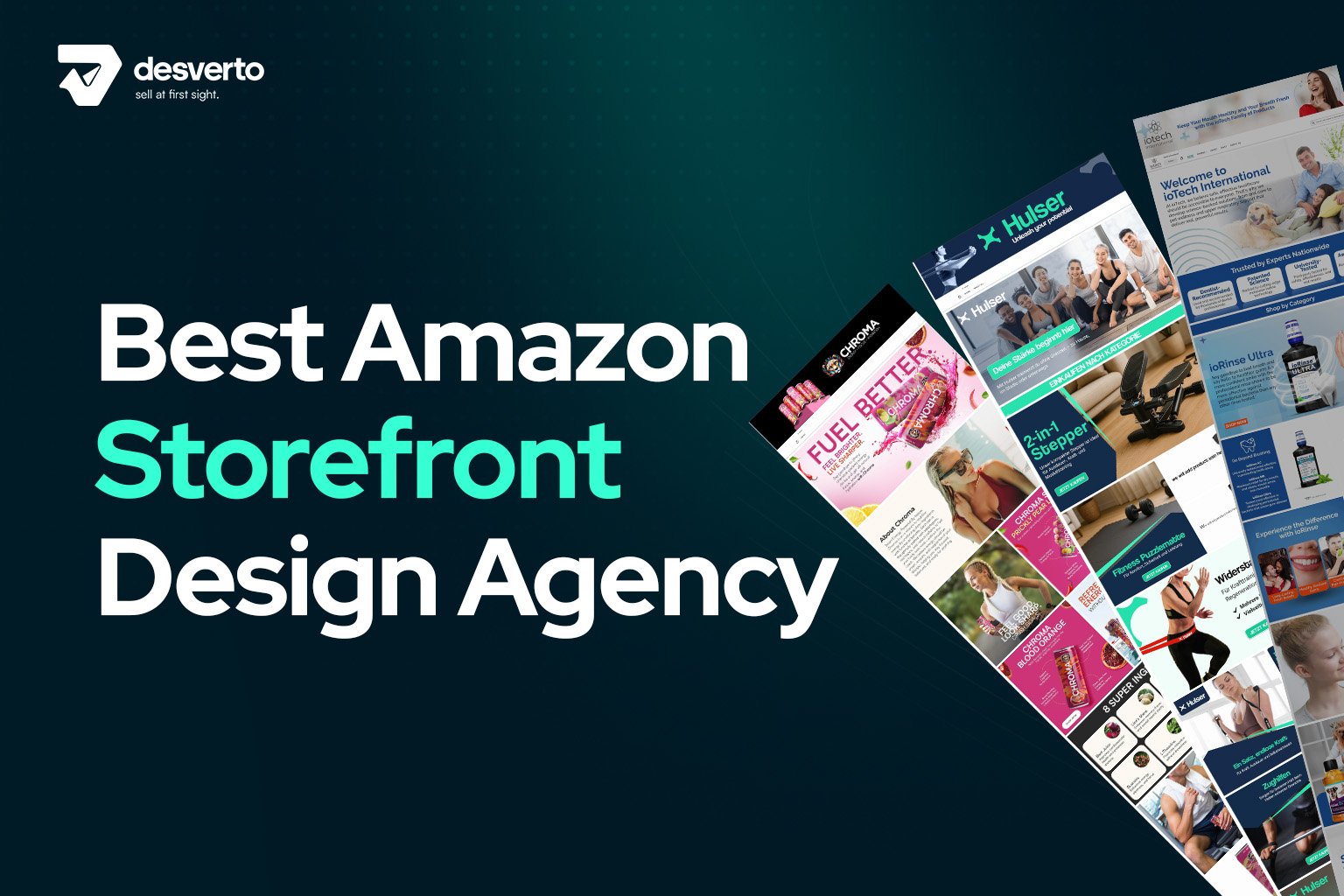



Most sellers searching for Amazon photography are shopping for two different things at once. One is the raw photo: a clean white-background shot, a lifestyle scene, and a model holding the product. The other is the finished image set that actually sells: seven slots built around buyer objections, infographics that answer questions before they get asked, and a main image engineered for click-through. The first is a photographer’s job. The second is a creative strategist’s job. Plenty of providers do one well and sell it as the other.
That gap is why two brands can both hire “an Amazon photography agency” and end up with completely different outcomes. A studio ships you beautiful files. A creative agency ships you a listing that converts. Sometimes you need one. More often than not, you need both to work from the same plan.
This guide compares 11 providers and sorts them by which job they actually do, how fast they move, and who they fit, with a dedicated pricing section that lays out what each one charges. Prices are pulled from each provider’s published pricing as of June 2026. When a provider keeps pricing private, we say so rather than guessing. Read the first section before the rankings. Picking the wrong type of provider is the most expensive mistake in this category, and it has nothing to do with your budget.
What kind of Amazon image work do you actually need?
Before comparing providers, get clear on the job. The category hides two separate services under a single search term, and the providers that win in one are often weak in the other.
Product photography (the raw shots)
This captures the product itself: white-background hero shots, lifestyle scenes, model shots, 360 spins, and detail close-ups. The work is done in a studio or on location and is priced per image or per shoot. You need it when you have a physical product that has to be photographed well, and you either already have a design plan or an in-house designer who will turn those shots into a finished listing. A pure photography studio is the right call here.
Listing image design (the set that converts)
This is building the seven-slot image set that does the selling: the main image, infographics that translate features into benefits, a comparison image, a how-to-use sequence, and the A+ Content modules below the fold. The work is strategy first, design second. Someone decides what each slot says, which buyer objection it answers, and how the whole set reads on a phone screen where most of your traffic lives. A creative agency or a specialist designer owns this job.
When you need both
Most private-label brands need both, and the two should feed each other. Hire a studio with no design plan, and you get attractive photos that don’t convert because no one has decided what story the images need to tell. Hire a designer with no shots, and you get polished graphics wrapped around weak source images. The most valuable providers work from a single brief, so the photography is shot for the infographics it will become, not in isolation.
Picture a supplement brand that pays a studio for clean bottle shots then hands them to a separate designer. The designer needs a top-down angle for the dosage infographic but the studio captured everything at eye level. Now you pay to reshoot. One brief covering both jobs avoids the gap.
| Use every slot you are given
Amazon allows up to seven images on most listings, and brand-registered sellers can add a video plus A+ Content below the description. Treat all seven slots as required, not optional. Listings that fill only three or four image slots leave conversion on the table against competitors who use the full set. |
What to look for in an Amazon image partner
The right provider clears six checks. Use these as your filter while you read the rankings.
Amazon compliance knowledge. They should know the current main-image rules cold and design for them, not learn them from your rejection notice. Compliance failures cost you a relaunch, not just a revision.
Mobile-first design. The majority of Amazon shoppers are on a phone. Infographic text that reads fine on a desktop mockup can be unreadable at thumbnail size. Ask to see mobile previews.
Infographic and A+ capability. A provider that only shoots photos solves half your problem. If they cannot build the infographics and A+ modules, you will need to hire a second vendor and split your visual identity.
Turnaround and revisions. Get the number of revision rounds in writing and what extra rounds cost. Most reputable providers include two to three rounds. Open-ended revisions usually mean a slow process.
Source files and ownership. You want the editable PSD or AI files, not just flattened JPGs. Without source files, every future tweak means starting over or going back to the same vendor.
Category fit. A studio that shoots fashion brilliantly may have never lit a supplement bottle or styled food. Ask for work in your category, not just their best portfolio piece.
Quick comparison: all 11 providers at a glance
The prices below are starting points based on each provider’s public pricing as of June 2026. Providers that do not publish rates are marked as custom. Type tells you which job the provider is built for, which matters more than price.
| Provider | Type | Photo | Design & A+ | Starting price | Turnaround | Best for |
| Desverto | Agency | Yes | Yes | Custom (contact) | 5 to 7 days | Full-service creative, images built to convert |
| Socilify | Agency | Yes | Yes | Custom (contact) | Varies | Creative-led design for growing brands |
| AMZ One Step | Agency | Yes | Yes | $195 / $750 / $995 | 48 to 72 hrs | Tiered plans, AI-fast to full studio |
| Squareshot | Studio | Yes | No | From $50/image | Varies | Transparent per-image studio shoots |
| soona | Studio | Yes | Partial | From $273/pack | About 24 hrs | Fast packaged content, incl. video |
| ProductPhotography.com | Studio | Yes | No | From $33/photo | Varies | Budget mail-in hero shots |
| Kenji ROI | Agency | Yes | Yes | $795 to $3,388 | 7 to 10 days | Photo-plus-listing combos |
| Shootify | Studio | Yes | Partial | From $26/photo | 8 business days | Lowest per-photo entry point |
| My Amazon Guy | Agency | Limited | Yes | $350 to $1,000 | Varies | Design plus account management |
| Evolve Media | Agency | Yes | Partial | $95 to $745+ | 5 to 14 days | Hybrid AI and studio model |
| Pixelz | Post-prod | No | No | $95 to $1,995/mo | Next morning | High-volume retouching at scale |
How Amazon image pricing actually works
Pricing in this category typically follows five common models. Understanding which one you’re evaluating can help you avoid both sticker shock and misleading savings, since the lowest per-unit rate doesn’t always translate to the lowest total listing cost.
- Per image: You pay for each individual image produced.
- Per shoot or session: A flat fee for a set amount of studio time.
- Per package: A fixed bundle of services and deliverables for one price.
- Hybrid (Real + AI): Combines real product photography with AI-generated enhancements, backgrounds, or lifestyle scenes to reduce costs and speed up production.
- Subscription or volume-based: Monthly capacity or discounted pricing for ongoing, high-volume work.
For large product catalogs, many agencies also offer catalog-scale pricing, which is typically customized based on image volume, project complexity, and turnaround requirements.
One more thing to check: what the price includes. Many studio rates cover the shot but charge for retouching, transparent backgrounds, alternative file formats, and rush delivery as paid add-ons. When comparing two quotes, compare the finished deliverable, the number of usable images, the file formats, and the revision rounds, not the per-image headline number. Paying per image for a 300-SKU catalog is how brands end up optimizing their top 10 products and abandoning the rest.
As a rough planning guide: a single SKU refresh runs a few hundred dollars at a studio and into four figures for a fully designed set with A+. A 20 to 50 SKU catalog is where package or session pricing usually pays off. Beyond about 100 SKUs, per-image and per-package math no longer scales, and catalog-level pricing tied to a reusable design system becomes the only model that keeps per-SKU cost reasonable.
The 11 best Amazon product photography and listing image agencies
The list runs from full-service creative agencies through dedicated studios to post-production specialists. Each entry covers who it is best for, what it does, where it stands out, and where it falls short. What each provider charges is covered in the pricing section above.
1. Desverto

Best for: brands that want a complete, conversion-built image set rather than a folder of raw files.
Desverto is an Amazon-first creative agency that builds the full visual layer of a listing: main image, infographics, lifestyle, comparison, A+ Content, Brand Story, storefront, and packaging. Photography is part of that. The team handles in-studio white-background and studio lifestyle shots, plus 3D renders for products that are hard or costly to photograph. For large on-location or model-heavy productions, Desverto brings in specialist shooters rather than pretending to be a high-volume studio.
What lets the work scale is two systems. Product Family Architecture groups a catalog into families so design decisions carry across related SKUs instead of being rebuilt for every ASIN. The Master Layout System maintains a consistent visual structure across a 100- to 500+ SKU catalog without the per-listing cost that most studios charge. For variant-heavy products, three content tiers (Specific, Generic, and Mix) let a brand decide how much variant-level design it pays for.
The credentials behind that: 1,000+ brands served, 3,500+ optimized listings, 1,900+ five-star reviews across Clutch, Behance, Trustpilot, Sortlist, and Fiverr, Fiverr Pro Top Rated, Amazon Verified Creative Partner, and Amazon SPN member. The
The design side uses the same conversion logic as the photography, which is why the Amazon listing image design and A+ Content design come from a single brief rather than two disconnected vendors.
On the photography side specifically, the deliverable is the full seven-slot set rather than loose files: white-background main image, studio lifestyle, infographics, comparison, and the A+ modules, handed over with editable source files, SEO alt text, and mobile previews so the set reads as one story on a phone.
Where they fall short: if you only need 20 raw white-background photos shot and nothing designed around them, a dedicated studio will be faster and cheaper. Desverto is built for brands that want the photos and the conversion strategy from one team.
Pricing:
Pricing is based on catalog size and the content tier a brand selects, so you pay for the amount of variant-level work you actually need. No pricing is listed on the official site. Contact desverto.com for a custom quote.
2. Socilify
Best for: growing brands that want a creative-led design partner on a focused project.
Socilify is an independent creative studio working with ecommerce brands on visual content and design. It fits brands that want strong creative direction without committing to a full account engagement, and it works well as a design partner when the photography is already handled. The studio’s strength is creative direction, so it suits brands that want a distinct visual identity rather than a fill-in-the-blank set.
Where they fall short: Socilify’s exact scope for Amazon photography and listing images should be confirmed against current service details before you commit, since the catalog of deliverables is narrower than that of a full-stack Amazon agency. [PUBLISHER FLAG: confirm Socilify Amazon photography and listing-image scope, deliverables, and pricing before publishing this entry.]
Pricing:
No pricing is listed on the official site. Contact socilify.com for a custom quote.
3. AMZ One Step
Best for: sellers who want photography tiered from fast and cheap to full studio production.
AMZ One Step is an Amazon creative and advertising agency that packages photography into three clear tiers. The entry tier leans on AI-assisted imagery and delivers a set of 7 to 10 listing images (main, infographics, and lifestyle) on a 48 to 72-hour turnaround, built for high-volume launches. The middle tier mixes AI and studio work with full creative direction and split testing. The premium tier adds real studio and lifestyle shots, models, props, set design, and a dedicated creative director and account manager.
The tiers map cleanly to launch stage and budget. Because the agency also runs advertising, image decisions can be tied to ad performance rather than made in a vacuum.
Where they fall short: the entry tier’s speed comes from generated imagery, which carries compliance risk on main images. Brands in regulated categories should confirm what is photographed versus generated before they buy the cheapest tier.
Pricing:
Per package. AMZ One Step offers three tiers: $195 (AI Photography), $750 (Hybrid Plan), and $995 (Studio Photography).
4. Squareshot
Best for: brands that want transparent, predictable studio shoots with itemized add-ons.
Squareshot runs a ship-and-shoot studio model. You ship the product, choose product shoots, model shoots, or its newer AI service, and direct the work remotely. Add-ons are itemized rather than bundled, covering steaming, transparent backgrounds, PSD and TIFF file formats, product recoloring, and styling, so you only pay for the extras you actually use.
The itemized structure is rare in a studio and helps keep costs under control for brands that know exactly which shots they want. The ship-and-shoot logistics also remove the need to source your own props or models.
Where they fall short: Squareshot delivers excellent photos, not an Amazon listing strategy. You still need someone to turn those shots into infographics and an A+ layout, so budget for a designer on top of that.
Pricing:
Per shoot or session. Squareshot charges $750 for a two-hour product shoot and $2,950 for a four-hour model shoot, and its AI service runs $975 for a five-image campaign. Better value when you need many shots captured in one sitting.
5. soona
Best for: brands that want fast, packaged Amazon content including video.
soona sells Amazon-specific content packs through a virtual platform where you can direct the shoot remotely. Packs range from a listing starter set through A+ basic and premium packs up to a complete content kit, and video packs (360 spin and product overview) are available separately. Some packs include pre-designed infographics, which give you a partial design layer out of the box. Turnaround is fast, often around 24 hours for standard shoots.
The packaged structure makes the scope predictable, and the remote direction means you can steer the shoot without traveling there.
Where they fall short: the included infographics are produced to a fixed structure, so they suit straightforward products better than complex ones that need custom feature storytelling or strict category compliance.
Pricing:
Per package. soona’s Amazon packs run from $273 for a listing starter set through $629 and $999 for A+ basic and premium, up to $2,499 for a complete content kit, with video packs from $261. Predictable, though you may pay for parts of the bundle you do not need.
6. ProductPhotography
Best for: sellers on a budget who need clean, compliant hero shots through a simple mail-in process.
ProductPhotography runs a straightforward ship-and-shoot studio that covers white-background, hero, and lifestyle shots, with add-ons such as transparencies, hand modeling, and ghost mannequins. You ship the product, the team shoots it, and you download the files from a private gallery.
The model is one of the most affordable ways to get compliant main images, and the per-photo add-on structure keeps catalog costs predictable.
Where they fall short: this is photography, not creative direction. The output is clean source imagery that still needs an infographic and an A+ layer to convert, and complex creative shoots are outside the model.
Pricing:
Per image. You pay for each shot. ProductPhotography starts at $33 per photo for white-background shots, $115 for hero shots, and $195 for lifestyle, with add-ons such as transparencies at $9, hand modeling at $35, and ghost mannequins at $30 per photo.
7. Kenji ROI
Best for: SEO-first sellers who want photography, copy, and A+ in one order.
Kenji ROI sells combo packages that pair a photo package with listing copywriting and at higher tiers, A+ Content and video. Bundling means your images, copy, and keywords are produced together rather than in separate orders, so the messaging stays consistent across the visuals and the text.
For sellers who value keyword-driven listings, having photography and SEO copy under one roof is efficient.
Where they fall short: the combos are structured around set packages, so brands that want only photography or only a heavy design treatment may pay for parts of the bundle they do not need.
Pricing:
Per package. Kenji ROI sells combos at $795 (Silver: photo plus copy), $1,497 (Gold: photo plus copy and A+), and $3,388 (Platinum: photo plus copy, A+, and video).
8. Shootify
Best for: high-volume sellers who want a low per-photo rate with no minimum order.
Shootify offers photo, video, 3D, and AI ecommerce imagery with no minimum order, so it is practical even when you only need a handful of images. Plans include basic retouching and an 8-business-day delivery window, with rush delivery available.
The spread across content types lets a brand source several formats from one provider, and the no-minimum policy suits small or staggered orders.
Where they fall short: at this level, the work is volume photography rather than bespoke creative strategy. Expect solid execution against your brief, not a partner who shapes the conversion plan for you.
Pricing:
Per Image. Shootify starts at $26 per photo, with video from $65, 3D from $350, and AI imagery from $78. Squareshot product shoots start at $50 per image and model shoots at $95. Predictable for a small, defined job, but it adds up fast across a full catalog.
9. My Amazon Guy

Best for: sellers who want listing image design bundled with broader account management.
My Amazon Guy is a large full-service Amazon agency whose listing image design is sold in tiers covering 5, 7, or up to 10 images, delivered as zoom-ready 2000 by 2000-pixel files with infographics and lifestyle shots, plus a separate option for 3D-rendered packaging imagery. The design work sits alongside SEO, PPC, and account management, so a brand can consolidate vendors.
For sellers who want design handled by the same team that runs their ads and account, the bundle reduces coordination overhead and keeps visual work aligned with the overall account strategy.
Where they fall short: you are buying into a large full-service operation, so the creative is one line on a broad menu rather than the core specialty. Brands that want photography-led creative as the main event may prefer a focused studio or creative agency.
Pricing:
Per package. My Amazon Guy prices the listing image design at $350 for 3D packaging, $400 for 5 images, $500 for 7 images, and $1,000 for up to 10 images.
10. Evolve Media Agency
Best for: brands that want a hybrid of real photography and AI-generated variations.
Evolve Media positions itself around a hybrid model: real shots for main images and core lifestyle, with AI used to generate variations for testing different scenes, demographics, and use cases. The pitch addresses a real workflow problem: photography for images that must be accurate and AI for the volume of test variations.
For brands that want to A/B-test scenes without booking a new shoot each time, the hybrid approach helps control costs.
Where they fall short: AI-generated variations have to be checked against Amazon’s main-image accuracy rules. The model works best when a brand understands which images can be generated and which must be photographed.
Pricing:
Hybrid (real plus AI). Evolve Media prices hybrid AI photography at $95 to $495 and traditional-only photography at $295 to $745 and up, the idea being real shots for the images that must be accurate and AI for cheaper test variations.
11. Pixelz
Best for: brands and studios that already have shots and need high-volume retouching at scale.
Pixelz is a post-production specialist, not a shooting studio. It handles advanced retouching, color matching, and fast, high-volume turnaround, with capacity designed for retailers and studios processing hundreds of images. For a brand shooting in-house or a studio needing overflow editing, it is a fast, consistent way to process large volumes of images.
The work is consistent at scale: the same color treatment and clean edges across hundreds of images, which matters in catalogs where mismatched retouching can make a brand look careless. It pairs naturally with a studio or in-house shooter who captures raw footage.
Where they fall short: Pixelz edits images. It does not create them or design listings. You need a source of raw photography and a design partner before retouching is relevant.
Pricing:
Subscription or per-volume. Pixelz runs from $95 per month at the professional tier (image prices start at $0.95 with volume discounts) up to $1,995 per month at the enterprise tier. Built for processing hundreds of images on a schedule.
Photography vs design vs DIY: which makes sense for you
The provider you pick should depend on your job, your catalog size, and how much creative control you need. Here is how to decide.
When to hire a photography studio
Hire a studio when you have a physical product that needs to be captured well, and you already have a plan for what the finished listing will look like. Studios are the right call for white-background hero shots, lifestyle scenes, and model work. They are most cost-effective when you know exactly which shots you need, and you have an in-house designer or agency ready to turn those files into a converting set.
When to hire a creative agency
Hire an agency when you need strategy plus design across the full image set or when your catalog is too large for per-image studio pricing to make sense. An agency decides what each slot says, builds the infographics and A+ modules, and keeps the visual system consistent across a 50, 200, or 500-SKU catalog. This is also the right choice when you want photography and design coming from one brief, so the shots are captured for the infographics they will become.
When AI and Canva are enough (and when they hurt you)
AI image tools like Booth.ai and Photoroom, and design tools like Canva are fine for early concepts, social posts, and rough mockups to align your team. They are not safe for your Amazon main image. AI generators struggle to accurately represent a real product, and a main image that misrepresents the product can be pulled by Amazon. Canva templates rarely meet the exact main-image rules and tend to read as generic against custom work. Use these tools to think, not to publish your core listing assets.
| AI main images are a compliance risk
Amazon’s main-image policy requires an accurate representation of the actual product on a pure white background, with no graphics, text, or props. AI-generated main images often invent details, alter proportions, or add elements not present on the real product. That can trigger image suppression or removal. Keep AI for secondary test variations, and photograph or 3D-render the main image from the real product. |
How photos and infographics work as one system
A great photo is not the deliverable. The deliverable is a sequence of images that moves a shopper from curiosity to purchase in about three seconds of scrolling. The main image earns the click. The second and third images answer the first two objections. The infographics translate specs into benefits. The comparison image positions you against the obvious alternative. The A+ Content closes the gap for shoppers who scroll to the bottom. When those pieces are made in isolation, they fight each other. When they are made from one plan, they compound.
This is why the photo should be shot for the infographic it will become. If the design plan calls for a feature callout on the product’s base, the shot needs an angle that shows the base. If a comparison image needs the product next to a competing format, that has to be planned before the shoot, not discovered after. A studio working without a design brief cannot make those calls, which is how brands end up reshooting.
At catalog scale, the system matters even more. Product Family Architecture groups related SKUs so a single design decision applies across a family, and the Master Layout System keeps the visual structure consistent across hundreds of listings without rebuilding each one. That is the difference between optimizing your top 10 products and leaving the other 190 untouched and treating the whole catalog as one coherent image system.
Best Amazon image providers by product category
Category changes what good imagery looks like and which providers are a good fit. Quick guidance by vertical.
Supplements and beauty
These categories live and die on ingredient callouts, claim-safe imagery, and lifestyle that signals results without overpromising. The work needs a designer who understands what claims are allowed on an image. Strong fits: Desverto for the full claim-aware set and ProductPhotography.com for clean bottle and jar hero shots to build on.
Electronics and tech
Tech buyers want technical infographics, spec translation, comparison charts, and scale references. The challenge is making dense specs scannable on mobile. Strong fits: Desverto for the infographic and comparison layer, AMZ One Step for studio shots with feature emphasis.
Food and grocery
Food sells on appeal to appetite and trust, which means styled food photography, a clear nutrition layout, and packaging that reads at thumbnail size. Strong fits: a styling-capable studio like Squareshot or soona for the shots, paired with Desverto for the nutrition and benefit infographics.
Home and kitchen
Home products need room-scene lifestyle images, dimension infographics, and use-case sequences that show the product in context.
Strong fits: Desverto for the use case and dimension design, and a lifestyle-capable studio for the room scenes.
| What changed from 2025 to 2026
Amazon’s technical image specs have stayed stable for years, but enforcement has gotten stricter. The platform now proactively flags and can replace main images it deems low-quality or non-compliant. The practical rule: a main image at 1,600 pixels or larger on the longest side, a pure white background, and the product filling 85 percent or more of the frame, with zero text or graphics. Build to that standard from the start. |
Amazon image requirements your agency should already know
A provider that designs around Amazon’s rules saves you a relaunch. The main image must use a pure white background (RGB 255, 255, 255), the product must fill at least 85 percent of the frame, and there can be no text, graphics, watermarks, or props. The longest side should be at least 1,000 pixels to enable zoom, with 1,600 pixels or larger recommended. Secondary images and A+ modules have more creative freedom, but they still have their own size and format specs.
Enforcement has tightened. Through 2025 and into 2026, Amazon has been more aggressive about flagging and replacing brand images that its systems judge to be low-quality or non-compliant, sometimes substituting an automated version. That makes getting the main image right the first time more important than it used to be.
| The mistake that gets the main images suppressed
Adding badges, text, logos, or promotional graphics to the main image is the most common reason a listing image gets suppressed. Save the callouts, comparisons, and badges for secondary images, where they belong and where they convert. The main image earns the click on its own. |
What a strong image deliverable includes
When you hire a provider, you should receive more than a set of JPGs. A complete deliverable tells you whether you are working with a professional or a freelancer cutting corners.
- The full image set is sized to Amazon’s specs, delivered as zoom-ready files (commonly 2000 by 2000 pixels).
- Editable source files in PSD or AI, so future tweaks do not mean starting from scratch.
- SEO-aware alt text and captions for each image.
- Mobile previews showing how the set reads at a thumbnail and on a phone.
- A defined number of revision rounds in writing, with the cost of extra rounds stated up front.
- Publishing instructions covering image order and placement, plus a short style guide documenting the design choices for future consistency.
If a provider cannot describe these before you pay, treat that as a signal. The brands that get burned usually skip this conversation.
Questions to ask before you hire
A short list of questions will tell you in five minutes whether a provider is a partner or a vendor processing an order.
- Are these images photographed, 3D-rendered, or AI-generated? The answer affects compliance with your main image.
- Do you design the infographics and A+ modules or only shoot the photos? If only photos, plan to hire a designer too.
- How many revision rounds are included, and what do extra rounds cost?
- Do I receive editable source files in PSD or AI, or only flattened JPGs?
- Can you show me full sets in my category at mobile size, not just hero shots?
- Who owns the final files and the source files after delivery?
- How do you handle products with multiple color, size, or flavor variants?
- What is your turnaround, and what happens if Amazon rejects an image after upload?
Strong providers answer these without hesitation and usually volunteer the detail before you ask. Hesitation, vague answers, or a hard push toward the cheapest option are all worth noting.
Red flags that signal a weak provider
A few patterns reliably separate the providers that protect your conversion rate from the ones that will cost you a relaunch.
- JPGs only, no source files. Every future edit means starting over or going back to the same vendor.
- Unlimited or undefined revisions. This usually means a slow, unscoped process rather than generosity.
- A portfolio of single hero shots with no full sets and no infographics. It tells you they shoot but do not build converting listings.
- No examples in your category. Lighting a supplement bottle is not the same job as shooting apparel.
- AI main images sold as a feature with no mention of compliance. That is a risk dressed up as a benefit.
- An inability to state Amazon’s current main-image rules from memory. If they do not know the rules, they cannot design around them.
None of these is automatically disqualifying on its own. Two or three together is a clear sign to keep looking.
The real cost of weak or non-compliant images
Bad images are not a cosmetic problem. They are a math problem, and the cost compounds every day the listing is live.
Start with the main image. It is the single biggest factor in your click-through rate from search results. A weak main image leads to fewer clicks, which means fewer sessions, which means a lower ranking over time as Amazon interprets the poor engagement. Every dollar of ad spend you push to that listing buys traffic that bounces, because the images do not close the sale the click started.
Then there is compliance. A non-compliant main image can be suppressed or replaced, which can cost you the listing’s visibility until it is fixed. A reshoot is not just the studio fee. It is the weeks of lost sales while you wait. Getting the images right once is cheaper than getting them wrong and paying to redo them and far cheaper than paying for ads that drive traffic to a listing built to lose the sale.
See what a converting image set actually looks like
If you want to see how Desverto approaches Amazon PPC, the service page has the specifics: how we structure campaigns, what the reporting looks like, and what the engagement process involves.
If you are ready to talk about your account, browse our photography portfolio to see full Amazon image sets built around conversion. Visit desverto.com to start a conversation. We will audit your current setup and tell you honestly whether working together makes sense.