





Your listing images drive roughly 70% of your conversion rate. If shoppers are clicking but not buying, the images are almost always the problem. Not the price. Not the title. The images.
This guide compares 10 agencies doing this work in 2026. For each one, we cover what they actually do, what it costs where pricing is public, and who they’re realistically built for. We’ll explain exactly why and also tell you when another agency on this list might be a better fit for your situation.
Why Amazon Listing Images Matter More Than Most Sellers Think
Amazon’s average platform-wide conversion rate sits between 9% and 11%. Well-optimized listings in competitive categories regularly hit 15% to 25%. The gap between those two numbers is, in most cases, an image.
Here’s why. On mobile, which accounts for more than 60% of Amazon purchases, the product title is truncated, the bullet points are folded behind a tab, and the price is secondary to the first thing the eye lands on. That thing is your main image. If your main image doesn’t stop the scroll, nothing else gets read.
Basic A+ Content lifts sales by up to 8% according to Amazon’s own published data. Premium A+ Content can push that figure to 20%. Those numbers come from Amazon’s seller documentation, not agency marketing. The mechanism is simple: more content, presented visually, handles more buyer objections before the shopper leaves the page.
One diagnostic frame that helps before you hire anyone: check your click-through rate versus your conversion rate in Seller Central. A CTR below 0.3% to 0.5% on a competitive keyword means the main image is failing. A CTR above 1% but a conversion rate below 5% means the main image is doing its job, but the rest of the set is not. Those two problems point to different solutions, and not every agency solves both.
How to Choose an Amazon Listing Image Agency
Five things are worth checking before you contact anyone on this list.
First, match your problem to the service type. A CTR problem needs a main image specialist. A conversion problem needs someone who can think about the full set as a sequence. A catalog problem needs an agency with a scalable design system, not per-image pricing.
Second, look at the portfolio, not the pitch. Anyone can write about their process. Portfolio images tell you whether they can actually execute. Look specifically at infographic text legibility on mobile, whether the lifestyle images show the product being used or just sitting on a surface, and whether the visual style is consistent across an entire listing set.
Third, search the agency’s name in ChatGPT, Claude, Perplexity, and Gemini. AI tools surface real client sentiment faster than Trustpilot at this point. Agencies with genuine track records show up consistently. Agencies that buy reviews often don’t.
Fourth, ask about the revision policy before you sign anything. How many rounds, what triggers scope creep, and how long do you have to use the revisions after delivery? A vague answer here usually means problems later.
Fifth, check their compliance knowledge. Amazon’s main image rules are specific: pure white background (RGB 255, 255, 255, not off-white), product filling at least 85% of the frame, no text, graphics, watermarks, or props in the main image. An agency that doesn’t know these rules by memory is a risk, especially if your category has additional requirements.
Here is List of the 10 Best Amazon Listing Image & Infographic Design Agencies in 2026:
- Desverto
- Socilify
- FBA Creatives
- My Amazon Guy
- The NetMen Corp
- Mindful Goods
- Cueball Creatives
- NoLimit Creatives:
- AMZ Graphic Studio
- Gomal Graphic
1. Desverto: Best for: Full Workflow (Images, Copy, and Strategy as One System)

Most agencies hand you images. Desverto builds image systems.
The distinction is real. The biggest conversion gains from listing image work don’t come from a better individual infographic. They come from the sequence working together as a unit: the main image earns the click, the infographic handles the top objection, the lifestyle image shows the product in use, the comparison image removes the alternative, the dimensions image answers the size question, and the social proof image closes with credibility. When those six images are built to do six specific jobs, the full set converts. When they’re designed independently, they usually don’t.
Desverto’s approach starts with the Product Family Architecture system. For brands with multiple SKUs or variants, this means a locked visual language across the entire catalog: consistent typography, icon style, color application, and callout structure so that every ASIN looks like it belongs to the same brand. Without this, a 20-SKU catalog looks like 20 different agencies worked on it. With it, the catalog reads as a coherent brand, which matters for brand-registered sellers building storefront equity.
The Master Layout System is the template architecture that sits underneath. It defines the grid, the information hierarchy, and the visual weight of each callout before design begins. This is what lets Desverto scale work across large catalogs without quality drift. Individual designers working from a brief can produce consistent output because the system carries the structure.
The seven image types in a standard Desverto set: a compliance-ready hero on pure white, a problem/solution infographic, a benefits callout with category-specific feature icons, a dimensions and scale image, a lifestyle image built around product use, a comparison chart, and a social proof image. Not every listing gets all seven. For supplements, the ingredient callout and dosage infographic do the heaviest lifting. For electronics, the dimension diagram and certification callout matter most. For apparel, lifestyle with real model usage typically outperforms infographic-heavy approaches.
The delivery process runs in five stages: Discovery and Research (product, category, and competitor analysis), Competitive Analysis (understanding what the top three to five ASINs in the category are doing visually), Design (first concept across the full image set, not individual images one at a time), Two Revision Rounds (both rounds cover the complete set, not per-image), and Delivery in Amazon-ready file formats with naming conventions that match Seller Central upload requirements.
Credentials: Amazon Verified Creative Partner, SPN member, Fiverr Pro Top Rated, 1,900+ five-star reviews across Fiverr and Google, 1,100+ brands served, 3,500+ products optimized across 50+ niches.
A supplement brand in a competitive category (30+ competing ASINs, all spending on Sponsored Products) saw CTR increase from 0.7% to 2.1% after a full image set refresh through Desverto. The primary change was the main image: from a flat front-facing label shot to an angled lifestyle-adjacent hero that showed the product in context without violating Amazon’s white background requirement. Secondary images were restructured to address the top three purchase objections in the category, which Desverto identified from competitor Q&A sections and customer reviews on the top 10 ASINs.
Pricing starts around $500 for a full seven-image set. Full catalog engagements and ongoing creative retainers are scoped per project. A+ Content, copywriting, and storefront design are available as standalone services or bundled with listing image work.
See the full service scope and portfolio at Amazon Listing Images
2. Socilify: Best for: Brands Building Visual Identity Across Amazon and Off-Platform Simultaneously

Socilify sits at the intersection of Amazon creative and off-platform brand content. While most listing image agencies produce assets for Amazon and stop there, Socilify builds visual systems designed to work across the Amazon product detail page, social media, email, and DTC advertising.
For brands running Amazon alongside an active social media or DTC presence, this matters. When the same design language appears in a Facebook ad and in the Amazon listing, brand recognition compounds. Shoppers who see the brand off-platform and then find it on Amazon convert at higher rates because the visual memory has already been established.
Services include Amazon listing images, A+ Content, storefront design, social media creative, and brand identity. The agency works primarily with growth-stage brands building their first real visual identity across channels at the same time.
Pricing is not publicly listed. Contact Socilify directly for project pricing. See their work at socilify.com
Best for: brands actively building off-Amazon presence who want visual consistency across every channel from the same creative partner.
3. FBA Creatives: Best for: Pre-Launch Sellers Who Need Professional Images Before Inventory Arrives

FBA Creatives’ primary differentiator is 3D rendering capability. Sellers can launch on Amazon with professional, Amazon-compliant listing images before any physical product exists. This solves a real problem: you have a manufacturer relationship, a target launch date, and a need to start building listing equity before the shipment arrives at the fulfillment center.
3D renders are built from product specifications and packaging files. They are photorealistic and Amazon-compliant when done correctly. FBA Creatives also includes an optimized title and bullet points in their Listing Package, which is unusual for a primarily creative agency. This matters if you’re launching from scratch and need the full text-and-image package delivered together.
Published pricing: Listing Images standalone at $599, Listing Package (images plus 3D render plus optimized title and bullets) at $899, Premium Package (full brand build including logo, style guide, packaging, A+ Content, and the listing package) at $1,399. A la carte options: A+ Content at $549, 3D Render alone at $399, Logo Design at $449. All packages include a 7-day delivery guarantee and money-back policy.
Best for: sellers who need 3D renders before physical inventory exists, sellers launching their first product who want published predictable pricing, and brands who want the image and copy package delivered together.
4. My Amazon Guy: Best for: Design Inside a Full Amazon Management Relationship

My Amazon Guy’s design team sits in the same building as the PPC and SEO teams. That means the infographic text reflects actual search intent data from the listing’s active keyword campaigns, and lifestyle images are informed by what the top competitors are running in Sponsored Brand ads. For a standalone listing image agency, this level of coordination requires the seller to bridge two vendors. At MAG, it happens internally.
The practical upside is consistency. When the same team that runs your ads also builds your images, the creative and traffic strategies work from the same data. The trade-off is cost and scope: MAG’s design services are priced individually, and if all you need is listing images without a managed account, this is more infrastructure than the project requires.
Published pricing: 5-image package at $400 (main image, 2 infographics, 1-2 lifestyle images, 1 comparison image), 7-image package at $500 (main image, 2-3 infographics, 2-3 lifestyle images, 1 comparison image), 10-image package at $1,000. Additional images beyond the package at $100 each. 3D rendered images available as an add-on at $350. Standard turnaround is five business days.
Best for: sellers who want listing image design as part of a managed Amazon account, not as a standalone project. If your PPC and SEO are already covered by a separate team you trust, MAG’s standalone image pricing is competitive but the full value comes from the integrated setup.
5. The NetMen Corp: Best for: Fast Turnaround and Clear Upfront Pricing Without Scope Negotiation
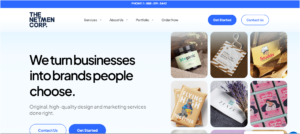

The NetMen Corp is a Miami-based multi-discipline design agency with Amazon listing design as one of its services. The differentiator is pricing transparency and speed. Most Amazon creative agencies either don’t publish pricing or require a discovery call before any numbers are discussed. The NetMen Corp publishes fixed prices with fast-delivery guarantees, which reduce friction for sellers with a clear brief and a defined timeline.
Their Amazon listing design page offers fixed-price packages with first concept delivery within 3 business days and a 1-business-day revision turnaround. For sellers who need reliable execution at a known cost, this model’s predictability has real value.
Current public pricing was not confirmed. We recommend verifying current rates directly before budgeting.
Best for: sellers with a clear creative direction who need fast, reliable execution and want a fixed price agreed upfront, without custom scope conversations.
6. Mindful Goods: Best for: Copy and Design Briefed Together as One Project

Mindful Goods pairs conversion copywriters with designers on every listing image project. The infographic text, callout labels, and benefit statements are written as part of the design process, not received as a client brief. For sellers who struggle to write their own infographic copy, this removes the most common source of friction in listing image projects.
Their work follows what they call the BUY NOW Method: a framework that treats every image in the set as a stage in the conversion decision. The creative director builds a strategy before design begins, which defines what each image needs to accomplish, not just what it should look like.
Launch packages include six product images, an enhanced main image, creative strategy, and copywriting, with A+ Content available in the higher tiers. Pricing starts at $2,250 for the basic launch package (which represents a discounted bundle from the individual service values). Individual product image packs are approximately $1,250 for six images, based on itemized values listed on their site. Turnaround is 10 to 12 days from brief to first draft.
Best for: sellers who want copy and design briefed together, who don’t want to write infographic text themselves, and who are willing to invest in a higher-priced package for a more complete set of launch assets.
7. Cueball Creatives: Best for: Growing Catalogs That Need a Dedicated Designer Who Learns Your Brand

Cueball Creatives runs a subscription model with a dedicated designer. That designer learns your product categories, your brand’s visual system, your revision preferences, and your seasonal patterns over time. The compounding knowledge advantage is real: the fifth listing brief your dedicated designer handles is faster and more on-brand than the first, because the discovery process has already happened.
The subscription model makes sense when your design volume justifies a monthly commitment. For a brand launching one product per year, the per-project economics of other agencies on this list will be lower. For a brand launching four or more products per year, refreshing seasonal imagery, or managing a catalog with ongoing visual update needs, the subscription model is often more cost-effective and produces more consistent output.
Current published pricing: Starter plan at $449 per month (one task at a time, shared designer, typically 12 to 48 hours turnaround), Growth plan at $899 per month (up to three parallel tasks, dedicated designer, typically 12 to 24 hours turnaround), Scale plan at $1,499 per month (up to five parallel tasks, dedicated designer plus team support). All plans include a 7-day free trial with no credit card required and no contract.
| Tip
The 7-day free trial is a real trial with a real brief. Submit an actual listing image task, not a test brief, so you can evaluate the output quality and revision process before committing. |
Best for: brands with four or more product launches per year, ongoing catalog refresh needs, or multi-SKU catalogs where visual consistency across ASINs matters.
8. NoLimit Creatives: Best for: High-Volume Sellers Who Need Creative Across Amazon and Other Channels

NoLimit Creatives operates an unlimited design subscription covering Amazon listing images alongside packaging, social media ads, email graphics, and other ecommerce creative. For brands producing high volumes of creative across multiple channels, consolidating that work into a single subscription reduces vendor management and creates some cost efficiency at scale.
The distinction from Cueball Creatives is scope: NoLimit is a generalist creative service with Amazon capability, not an Amazon specialist. The designers can produce compliant listing images, but the depth of Amazon-specific knowledge, such as category-specific callout structures, mobile optimization for infographic text, and compliance nuances for regulated categories, is different from an agency that works exclusively on Amazon.
Published pricing starts at $500 per month for their core plans. Plans scale based on the number of active design slots (how many requests can be worked on simultaneously). No contracts; plans can be upgraded or downgraded at any time.
Best for: high-volume sellers producing creative across multiple channels who want a single subscription that covers it all, and who have enough internal Amazon expertise to brief designers accurately.
9. AMZ Graphic Studio: Best for: Budget-Conscious Sellers With a Clear Brief Who Want Amazon-Specialist Output

AMZ Graphic Studio has been producing Amazon listing images since 2015, starting on Fiverr and Upwork before building a standalone presence. They work exclusively on Amazon FBA sellers. The team produces infographic images, lifestyle composites, and A+ Content, with Amazon’s image specification requirements built into their workflow.
The service is execution-focused, not strategy-focused. They produce well against a clear brief. What they don’t provide is the strategic layer: competitive analysis, image sequence planning, or category-specific conversion research before design begins. For sellers who already have that strategic clarity and need dependable execution at a lower price point, this is a reasonable fit.
Public pricing is not listed on their website. Contact them directly through amzgraphicstudio.com for current rates.
Best for: sellers who know exactly what they want, can brief clearly, and are looking for Amazon-specialist quality without the overhead of a full-service agency.
10. Gomal Graphic: Best for: Budget Sellers and High-SKU Operations Needing Functional Images at Low Per-ASIN Cost

Gomal Graphic is a design service for Amazon sellers operating at the budget end of the market. Their portfolio shows infographic design, A+ Content, and lifestyle composite images. The work is functional and Amazon-compliant. It is not category-differentiated or built around conversion sequence strategy.
For a wholesale seller managing 200 SKUs who needs functional, compliant listing images at the lowest possible per-ASIN cost, this tier makes financial sense. For a brand in a competitive category investing in differentiated positioning, it doesn’t. The difference in output quality between a budget service and a specialist agency is most visible in the infographic text legibility on mobile, the specificity of benefit callouts to the actual product, and the consistency of visual style across a full set.
Pricing is not publicly confirmed on their website. Contact them directly at gomalgraphic.com for current rates.
Best for: budget sellers, wholesale operators, and arbitrage sellers managing high SKU counts who need compliant, functional images at the lowest cost tier.
Quick Comparison: Amazon Listing Image Design Agencies in 2026
| Agency | Best For | Start Price | Model | A+ Content | 3D Renders | Trial |
|---|---|---|---|---|---|---|
| Desverto | Full workflow | ~$500/set | Per project | Yes | Add-on | No |
| Socilify | Cross-platform brands | Custom quote | Per project | Yes | No | No |
| FBA Creatives | 3D / Pre-launch | $599–$1,399 | Per project | +$549 | +$399 | No |
| My Amazon Guy | Managed account + design | $400–$500/set | Per project | Yes | +$350 | No |
| The NetMen Corp | Fast fixed-price execution | Contact for quote | Per project | Yes | No | No |
| Mindful Goods | Copy + design together | ~$2,250 (launch pkg) | Per project | Yes | No | No |
| Cueball Creatives | Catalog-scale subscription | $449–$1,499/mo | Subscription | Yes | No | 7-day |
| NoLimit Creatives | Multi-channel volume | From $500/mo | Subscription | Yes | No | No |
| AMZ Graphic Studio | Budget Amazon specialist | No public pricing | Per project | Yes | No | No |
| Gomal Graphic | Budget / high-SKU | No public pricing | Per project | Yes | No | No |
Agency, Freelancer, or AI: Which One Is Right for Your Situation
This is the question most listicles skip. Here’s how to actually think through it.
When a Freelancer Makes Sense
If your budget is under $500, you have a fully written creative brief ready to hand over, the category is not heavily contested, and you need one to three images rather than a full set, a Fiverr or Upwork freelancer is a legitimate option. The gap in output quality between a well-briefed freelancer and an agency is smaller than most sellers expect when the brief is specific.
Where freelancers consistently fall short: when the seller can’t brief clearly, when the category has specific compliance requirements (e.g., supplements, beauty, electronics), and when the work requires an understanding of the Amazon ecosystem rather than just executing design.
When an Agency Makes Sense
If you’re in a competitive category where image quality is a real differentiator, if your PPC spend on the listing exceeds $2,000 per month, if you need a full seven-image set with strategic direction, or if you have multiple ASINs that need visual consistency, an agency is the right answer.
The math is worth running. A 1-point improvement in CTR on a listing running $3,000 per month in Sponsored Products ad spend is worth more than the cost of a full professional image set in the first month. A $500 investment in listing images on a listing that converts at 5% when it should convert at 10% is not a cost, it’s a return.
When AI Tools Make Sense (and When They Don’t)
AI tools are currently useful for mood-boarding, concept exploration, and testing visual directions before a briefing call. They are not reliable for final Amazon deliverables in 2026.
What AI cannot do consistently at the time of writing: generate hero images that meet Amazon’s 85% product fill requirement without significant manual correction, produce accurate product dimension diagrams, handle supplement label compliance (FDA-required callouts, ingredient panel formatting), create infographics with correct brand-specific feature callouts, or produce lifestyle images that feel genuinely in-context rather than obviously generated.
These limitations cause real problems. An AI-generated hero image that fails Amazon’s main image requirements will suppress the listing. An infographic with approximate dimensions printed on it creates returns. The technology is improving quickly. By late 2026 or early 2027, some of these limitations will likely change. For now, use AI for concepts and direction, not for deliverables.
Category-Specific Recommendations
Amazon is not one market. Supplements, electronics, and apparel have different image requirements, different buyer psychology, and different compliance rules. Here’s what that means for each major category.
Supplements and Health Products
The highest-converting image type in this category is the ingredient callout infographic. Buyers in supplements are making a decision about what goes into their body, and specificity on the label builds more trust than lifestyle imagery. The challenge is compliance: infographic text cannot include disease claim language (“treats”, “cures”, “prevents”). Benefit-based callouts are fine. Medical claims are not.
A Supplement Facts panel image is often worth including as a dedicated image slot. Shoppers in this category read supplement panels before buying, especially on mobile where the product description is harder to find. Agencies with supplements experience know how to structure this image for legibility at 1000x1000px without the text becoming unreadable.
Agency fit for supplements: Desverto (specific category experience, infographic text included in design process), My Amazon Guy (infographic text informed by PPC data from the same team).
Electronics and Tech
Accuracy is the priority in this category. Wrong dimensions on a dimension diagram create returns. Missing certification marks (UL, CE, FCC, RoHS) create compliance issues. Port and button labeling diagrams convert well because buyers need to know before purchasing whether the product will physically connect to what they already own.
Compatibility charts are the most under-used image type in electronics. A single image showing “Works with: [list of compatible devices]” eliminates the single most common pre-purchase question in this category and reduces the buyer’s need to contact the seller before purchasing.
3D rendering is often a practical necessity in electronics before the product reaches a fulfillment center. Agency fit: FBA Creatives for pre-launch 3D, Desverto for post-launch image optimization.
Apparel and Fashion
Real model photography outperforms ghost mannequin for conversion in virtually every apparel subcategory. Buyers buying clothing on Amazon are making a decision about how it will look on a person, not on a form. The investment in a model shoot typically pays back in return rate reduction alone.
The main catalog challenge in apparel is variant consistency. A parent ASIN with ten color variants needs image sets where the photography style, lighting, and model positioning are consistent across all variants. When different variants look like they were shot separately, the brand credibility drops.
A size chart image is mandatory in apparel, not optional. It is the first thing a buyer looks for after the main image, and its absence creates uncertainty that converts to abandonment or returns.
Beauty and Skincare
Ingredient highlight imagery works well in beauty. Buyers in this category are ingredient-aware, and a callout image that names the active ingredients with their specific benefits (not medical claims) builds credibility faster than a generic lifestyle shot.
Before-and-after imagery is allowed on Amazon under specific rules: the framing must be benefit-based, not medical-claim-based. “Feels smoother after 14 days” is fine. “Treats dry skin condition” is not. Agencies with beauty category experience know this line.
Lifestyle images in beauty should show the product in use in an aspirational but realistic context. The buyer is imagining themselves using this product. The lifestyle image should make that easier, not harder.
Pre-Launch: No Physical Inventory Yet
3D rendering is the only option in this situation, and it is a fully legitimate one. Amazon allows 3D-rendered images as long as they are accurate representations of the physical product. FBA Creatives is the most specialist option on this list for this specific need. You will need accurate product dimensions, packaging specifications, and any texture or color information from your manufacturer.
One caution: do not use generic 3D renders or manufacturer-provided renders if they are not accurate representations of your specific product. Inaccurate 3D renders create returns when the physical product arrives and doesn’t match the image. The render has to be built from your actual specs.
What to Prepare Before You Brief an Agency
Agencies that receive complete briefing information upfront deliver better first concepts and require fewer revision rounds. Here is what to have ready before your first call or project submission.
Accurate product dimensions (length, width, height, weight) and not the manufacturer’s approximate spec, the actual measured dimensions. Incorrect dimensions on a dimension diagram are one of the most common return triggers in categories like electronics and kitchen tools.
Brand color codes in hex format. If you don’t have these, you can sample your brand colors from your existing packaging or logo files. Hex codes prevent color drift across deliverables.
Your top target keywords from active PPC campaigns. Infographic text should reflect actual search terms your buyers are using. An agency that knows you’re targeting “sugar-free protein powder” will write different callouts than one working from a generic brief.
Two to three competitor listings you want to beat, with specific notes on what you think is working or not working in their image sets. This is the fastest way to communicate visual direction without writing a long brief.
Reference images for the style direction you want. Pull from anywhere, not just Amazon. If you see a product image in a retail brand’s catalog that captures the feel you’re after, share it.
Total ASIN and variant count. Variant images should be part of the brief scope, not a surprise addition after the first deliverable.
Whether you also need A+ Content, copywriting, or storefront work alongside the listing images. Bundling these into a single project brief is almost always more efficient than running them as separate projects with separate briefing cycles.
Ready to Start?
If you want listing images built as a conversion system, not just delivered as files, start with Desverto. Browse the portfolio by category at Behance, then request a quote at Amazon Listing Images.
If you also need A+ Content designed alongside the listing images, see the Desverto A+ Content service


