Most Los Angeles brands hire an Amazon agency to run ads and manage the account, then wonder why the traffic never turns into sales. Ads buy the click. Creative wins the sale. If your listing images, A+ Content, and copy are not built to convert, more ad spend just pays to send shoppers to a page that loses them.
Best For: Los Angeles and Southern California brand owners in beauty and K-beauty, apparel and fashion, supplements, and creator or DTC lifestyle categories. Works for single-product sellers, variant-heavy catalogs, and multi-brand operators comparing agencies before they commit a budget.
What an Amazon Agency in Los Angeles Actually Does
An Amazon agency in Los Angeles manages some mix of three things for a brand: the advertising, the account operations, and the creative on the product page. Most agencies lead with the first two. They run Sponsored Products, Sponsored Brands, and DSP campaigns, handle Seller Central cases and inventory, and call that full service.
That covers traffic and operations. It leaves out the part that decides whether traffic becomes revenue.
Your product page gets judged by three different systems, and a page built for only one of them underperforms in the other two without anyone noticing why. The A9 and A10 algorithms decide whether you get found. The shopper decides whether they buy, based almost entirely on your images, A+ Content, and copy. Amazon’s Rufus assistant decides whether your product gets recommended in conversational search, which reads a different data layer than keyword rank. An agency that only touches ads and account health is working on one of those three jobs.
That gap is where Los Angeles brands lose money, and it is where we work first.
Why Los Angeles Brands Get the Amazon Agency Decision Wrong
Los Angeles has a dense field of Amazon agencies, plus dozens of pages built to rank for that exact search. Sorting them is harder than it looks, and the usual mistakes cost a lot.
Over-invested in ad spend, under-invested in creative.
The most common pattern we see is a brand pouring money into PPC while running listing images that were made once at launch and never touched. Ads raise the traffic. The conversion rate stays flat, so ACoS climbs, and the account looks like an advertising problem when it is a creative one.
Hiring on a “Los Angeles” claim that does not hold up.
Plenty of pages rank for this search without a real local operation behind them. Some list a US phone number next to a UK and UAE one and never state where the team actually sits. Where the agency is matters less than who is on your account, but a page that hides both should make you ask more questions, not fewer.
Buying ads only helps for a conversion problem.
A PPC specialist can lower your cost per click and still leave revenue on the table, because bids do not fix a main image that fails to explain the product in two seconds. If the page does not convert, better targeting just finds cheaper ways to lose the sale.
Amateur creative in categories that punish it hardest.
Beauty and apparel shoppers in this market compare on visuals first. A listing that looks homemade next to a polished competitor loses the click before copy or price ever enters the decision.
Account health is left alone until it breaks.
Suppressed listings, compliance flags, and restricted-category issues get ignored while everyone watches the ad dashboard, then turn into a suspension that stops sales entirely.
Backend fields left empty.
Attributes, intended use, and search terms get skipped at setup. That is invisible to a sales report and directly limits both keyword indexing and whether Rufus can match your product to a shopper's question.
Almost none of these show up in a monthly revenue number until they have already cost you.
What LA’s Biggest Amazon Categories Actually Demand
Los Angeles is not a generic seller market. A handful of categories dominate here, and each one changes what a good Amazon agency has to be able to do. This is the part most agency pages skip, and it is usually the fastest way to tell whether a partner understands your product.
Beauty and K-beauty.
The city has one of the densest beauty-seller populations in the country, much of it clustered around Koreatown’s K-beauty trade. These shoppers scrutinize ingredients, texture, and results. That demands ingredient callouts, before-and-after visuals, and A+ Content that answers formulation questions, not stock photography with a logo dropped on top. Our listing image work is built around exactly this kind of category-specific buyer research.
Apparel and fashion.
The Fashion District feeds a large base of apparel brands, and apparel means variant-heavy catalogs: sizes, colors, and styles that each need their own visuals to avoid confusing the buyer. Fit, drape, and lifestyle context sell the product, so the image set and the variation structure both have to be right.
Supplements, consumables, creator and DTC lifestyle brands.
Supplements and consumables. Southern California has a deep bench of supplement and wellness brands. These sit in gated categories with real compliance stakes: claims have to stay inside Amazon’s rules, and many products need FDA registration before they can even list. Creative here is about compliant benefit storytelling, not medical claims that get a listing suppressed.
Creator and DTC lifestyle brands. The city’s creator economy produces brands that already have an identity and a following, then move onto Amazon. For them, the job is carrying a consistent brand across the storefront, Brand Story, and A+ so the Amazon page does not feel like a downgrade from their own site.
There is also a logistics reality worth naming. The Ports of Los Angeles and Long Beach are the largest container gateways in the country, which makes the metro a natural FBA inbound hub for imported goods. Getting inventory in is rarely the constraint for a brand here. Converting the traffic once the product is live is.
What You Get
A build or fix scoped to what your account actually needs, not a fixed package with your logo dropped in.
Every engagement includes a category and competitor audit before any design or copy work starts. From there, the deliverable depends on scope, but the standard elements are a conversion diagnostic on your current creative, keyword, and backend coverage mapped across the listing, the creative and copy work itself with source files, and a plan that ranks the fixes by revenue impact so the highest-return work happens first.
For ongoing engagements, advertising and account management run against that foundation with monthly reporting. For one-off builds, we recommend a review once real sales and review data exist to optimize against.
You approve the work before anything goes live. Nothing gets published to your listings without your sign-off.
We are a creative-led Amazon agency. That means we start with the layer that decides whether traffic converts, then build the ads and operations around it. Every engagement opens with a category and competitor audit before we design or write anything.
Listing Images
Seven custom images per SKU, chosen by category behavior and the specific questions a shopper has before they buy. The main image is built for click-through, plus infographic, lifestyle, comparison, and dimension images matched to the product. This is our highest-demand service for a reason: the main image drives click-through more than any other single element on the page.
A+ Content, Standard & Premium
Image-and-text modules that replace the plain description on brand-registered listings. Standard and Premium A+ Content adds indexable text and answers the product questions that cause hesitation. Premium A+ opens up full-width layouts, interactive modules, and video once your brand qualifies for it.
Storefront & Brand Story
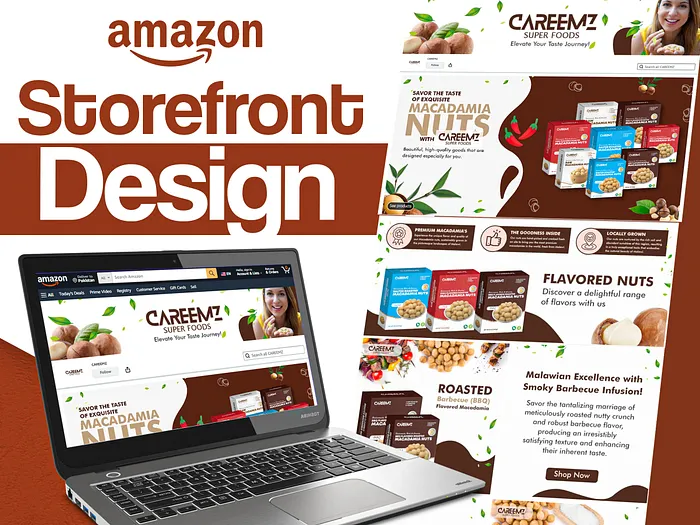
A multi-page Amazon storefront and the branded tile strip above your A+ that introduces the brand and cross-sells the catalog. For a brand that already has an identity, this is where it carries onto Amazon.
Copywriting & Amazon SEO
Titles, bullets, descriptions, and backend search terms built from keyword research and buyer-objection analysis, written to index and to sell at the same time. The primary keyword goes where Amazon weights it, inside the first 80 characters of the title, and the 249-byte backend field gets used for terms your title does not already cover.
Packaging & Brand Identity
For sellers building a brand rather than a single listing, print-ready packaging and a full identity system that stays consistent from the box to the detail page.
Compliance & Account Health
Category compliance review, listing reinstatement, and Brand Registry enrollment, so a fixable flag does not become a suspension.
PPC & Account Management
Once the page converts, our advertising and account-management team runs Sponsored Products, Sponsored Brands, and Sponsored Display, plus day-to-day Seller Central operations, as part of the same stack. This is the operational layer, delivered through our sister team Selouse, and it works better because it is scaling traffic to a page that is ready for it.
Rufus & AI-Search Readiness
For brands that want it, we structure the backend attributes, Q&A, and comparison data that Amazon's Rufus and COSMO layer reads to decide what to recommend in conversational search.
We set the priority order after the audit, not before it. For most brands, the conversion layer comes first, because scaling ads onto a page that does not convert is the most expensive way to grow.
On Pricing: How Amazon Agency Fees in Los Angeles Actually Work
Pricing in this market follows one of three models, and knowing which one you are being quoted matters more than the number itself.
Creative and listing work is usually a flat project fee, priced per ASIN or per deliverable, with volume pricing across a catalog. Account management and advertising run on a monthly retainer, sometimes a percentage of ad spend, sometimes a flat fee, sometimes a hybrid. Some agencies bundle everything into one monthly number.
What changes the price is the same short list every time: how many ASINs, how many variants, whether A+ and Rufus readiness are included, and how complex the advertising is. A single number quoted before anyone has seen your catalog is a placeholder that will move the moment the work is actually scoped. Ask for a scoped quote, and compare like against like, a project fee against a project fee and a retainer against a retainer, not one against the other.
We do not publish a flat price for the same reason. The audit tells us the scope, and the scope sets the number.
How to Vet an Amazon Agency in Los Angeles
The right questions on a first call will tell you more than any award badge on an agency’s homepage. Ask these before you sign anything.
1. Who works on my account day to day, and are they in-house or subcontracted?
2. Do you handle the creative that drives conversion, or only advertising and account management?
3. Who owns the account, the assets, and the source files if we part ways?
4. What exactly is included in the retainer, and what is billed separately?
5. How long is the contract, and what are the exit terms?
6. Can you show work in my category, at my catalog size?
One more, specific to this search. If an agency ranks as a “Los Angeles” agency, ask where the team actually sits and who will be on your account. Location matters less than competence, but an agency that is vague about both is telling you something. A good partner answers all of this plainly, because they have nothing to hide in the answers.
Where This Is Going: Agentic Commerce and Why Creative Wins
Amazon’s Rufus assistant already has account memory and is spreading across Kindle, Prime Video, and Alexa+. Every one of those surfaces reads the same underlying listing data: your backend attributes, your copy, your and your reviews. A listing built only for keyword rank hands that AI layer almost nothing to work with.The brands that win the next few years on Amazon are moving budget toward creative that converts and listings an AI can actually read and recommend, not toward more spend on pages built for a 2020 search box. An agency still selling ads first, creative-later has the order backwards. For a Los Angeles brand in a visually competitive category, that order is the whole game
“We’ve been working with desverto team for over a year on our Amazon brand. From A+ content to product images, they’ve consistently delivered high-quality work on time and exactly to our specs. Super reliable and easy to work with — highly recommended.”
“Desverto supported my Entire Amazon Launch — from A+ content to storefront. Everything turned out visually cohesive and professional. They were patient, detail-focused, and didn’t stop until it was perfect. Highly recommended!”
“Desverto helped me launch my skincare line on Amazon — from SEO and listing images to storefront design. Everything looked incredibly professional. Super responsive and went above and beyond every step. I’d definitely recommend them.”
“We’ve been working with desverto team for over a year on our Amazon brand. From A+ content to product images, they’ve consistently delivered high-quality work on time and exactly to our specs. Super reliable and easy to work with — highly recommended.”
“Desverto supported my Entire Amazon Launch — from A+ content to storefront. Everything turned out visually cohesive and professional. They were patient, detail-focused, and didn’t stop until it was perfect. Highly recommended!”
“Desverto helped me launch my skincare line on Amazon — from SEO and listing images to storefront design. Everything looked incredibly professional. Super responsive and went above and beyond every step. I’d definitely recommend them.”
It manages some mix of advertising, account operations, and product-page creative for a brand selling on Amazon. Most agencies lead with ads and account management. A creative-led agency starts with the images, A+, and copy that decide whether the traffic those ads buy actually converts.
How much does an Amazon agency in Los Angeles cost?
Creative and listing work is usually a flat project fee, priced per ASIN or catalog. Advertising and account management run on a monthly retainer, a percentage of ad spend, or a hybrid. The number depends on catalog size, variant count, and whether A+ and AI-search readiness are included, so ask for a scoped quote before comparing any two agencies.
Should I hire a local LA agency, or does location matter for Amazon?
Amazon work is done remotely, so competence and category experience matter more than a local address. What matters is who is actually on your account and whether they understand your category. If an agency is vague about where its team sits and who will do the work, treat that as a reason to ask more.
What is the difference between a full-service Amazon agency and a creative agency?
A full-service agency usually centers on advertising and account management, with creative treated as an add-on. A creative-led agency starts with the conversion layer, the images, A+, and copy, because ad spend on a page that does not convert is wasted. The strongest setup handles both, in that order.
Which product categories are biggest for Amazon sellers in Los Angeles?
Beauty and K-beauty, apparel and fashion, supplements, and creator or DTC lifestyle brands dominate the local market. Each demands something specific: ingredient-led visuals for beauty, variant-heavy image sets for apparel, and compliant claims for supplements. An agency that has worked in your category will move faster and make fewer mistakes.
Do you handle Amazon PPC and account management, or only creative?
Both. Creative and listing optimization is our lead service, and advertising plus full account management run as part of the same integrated stack. We sequence it so ads scale traffic to a page that is already built to convert.
Do you work with Los Angeles brands remotely?
Yes. We serve Los Angeles and Southern California brands remotely, the same way effective Amazon work is done everywhere. You get a team that knows your category and your account, without paying a premium for a local office you would never visit.
Do you guarantee a specific ranking or sales increase?
No, and any agency that guarantees a ranking or a sales number is worth avoiding. Amazon results depend on competition, pricing, reviews, and velocity, none of which an agency fully controls. What we control is whether your listing is built to compete across indexing, conversion, and AI recommendation instead of just one of the three.
Message from CEO
Our mission is to empower your growth through innovative solutions and unwavering dedication. we value trust, collaboration, and delivering excellence in everything we do.
Most Amazon agencies in Los Angeles will run your ads and manage your account. Very few will tell you that your creative is why the traffic is not converting. Book a free audit, bring your listings, and we will show you exactly where a brand like yours is losing the sale and what fixing it would take.